Smalls and Sporting
Collecting Victorian Hatpins
How to collect Victorian and Edwardian hatpins: lengths, materials, heads, marks and the holders that display them.
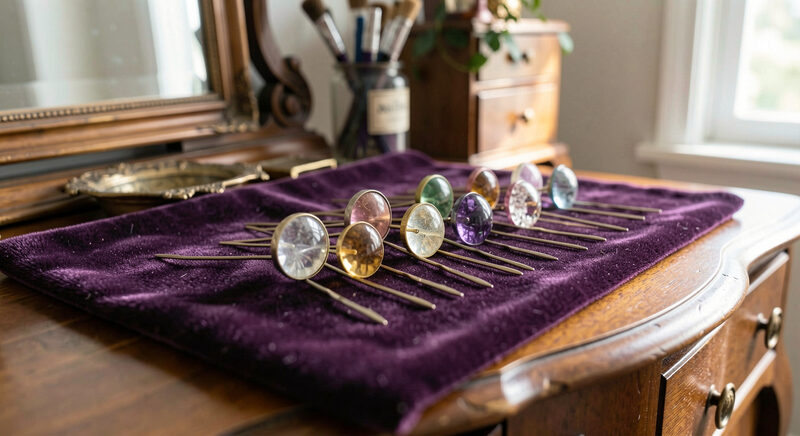
What a hatpin is
A hatpin is a long pin with a decorative head, used to fasten a hat to the hair. It is not the same as a tie pin or a brooch, though it shares materials with both. Its essential feature is length, because it had to pass through a hat and into a coil of hair, and that length is the first thing a collector notices. Hatpins were worn by women of every class, in plain forms and in elaborate ones, and they were sold in shops, in department stores and by mail order.
The hatpin belongs to a narrow window of fashion. It grew with the large hats of the late nineteenth century and it declined as hats became smaller in the twentieth. That window is what makes the field collectible, because it is short enough to be studied and wide enough to be varied.
Lengths and sizes
Hatpins range from a few inches to more than a foot, and their length is a guide to their period and their use. Shorter pins belong to the later years, when hats sat closer to the head. Longer pins belong to the earlier years, when hats were large and hair was piled high. A pin of ten inches or more is a striking object, and it was a striking object when it was made, since it held a large hat in place.
Length also affects condition. A long pin is more easily bent, and a bend is common. A collector should look along the shaft of a pin to check that it is straight, and should check the point for a break or a blunt tip. A pin that has been shortened has lost both its length and its period, and should be treated as a lesser object.
Materials and heads
The head of a hatpin is where the maker showed their skill, and the materials of the head are the main guide to quality. Glass heads were made in a great range of colours and shapes, from simple spheres to flowers and figures. Metal heads were made in brass, silver and gold, sometimes set with stones. Jet, a hard black material, was popular for mourning. Porcelain, enamel and paste stones all appear. The collector learns to recognise these materials by eye and by weight, and to tell a solid silver head from a plated one by its marks.
Marks on hatpins are often small and sometimes absent. Where a mark exists, it names the metal and may name the maker, and it should be read with a loupe. Where a mark is absent, the construction and the style carry the dating, and the two together usually place a pin within the period of the fashion.
Reading a hatpin before you buy
The reading of a hatpin follows the method used across this magazine. Look at the whole pin first, for proportion and for length. Then look at the head, for its material, its setting and its condition. Then look at the shaft, for straightness, for the point and for the join between shaft and head. Then look for a mark. A pin whose head is fine but whose shaft is bent can still be a good object, since the shaft is the plain part. A pin whose head has lost a stone or a petal is a lesser object, and the loss should be reflected in the price.
Reproduction hatpins exist and are common, since the object is simple to copy. A reproduction is often lighter, its head is cast rather than set, and its shaft is too uniform. The collector who handles a number of genuine pins will learn the feel of the real thing, and the feel is a better guide than any single feature.
Hatpin holders
The holder, a small stand with holes to receive the pins, is a field of its own and a natural companion to the pins. Holders were made in porcelain, glass, metal and wood, and they were decorated to match the taste of the period. A holder with its original decoration and no chips is a desirable object, and a collection of pins is often displayed on one. Because holders are small and fragile, they are often found chipped or repaired, and the collector should check the rim of every hole for a chip and the base for a crack.
Holders are also a dating tool. The style of a holder, from a simple cylinder to an elaborate figure, follows the same fashion as the pins it held, and the two can be read together. A collection that includes a holder and a set of pins from the same period tells a fuller story than either alone.
Care and display
Hatpins are small and easily lost, and a collection is best kept together. Store pins point down in a holder or in a lined box, so that the heads are visible and the points are safe. Keep them away from damp, which corrodes metal and clouds glass, and out of direct sun, which fades some glass and paste. Handle a pin by its shaft rather than its head, and never force a bent pin straight, since the metal will work harden and break.
The smalls and sporting guide on this site sets out the whole field of small objects, and the page on antique medicine bottles shows how another family of smalls is read by colour, shape and marks. Read both, and a drawer of odds and ends becomes a collection with names, periods and a history.