Antique Clocks
How an Antique Clock Is Restored
What a proper clock restoration covers, from cleaning a movement to replacing a suspension spring, and what to leave untouched.
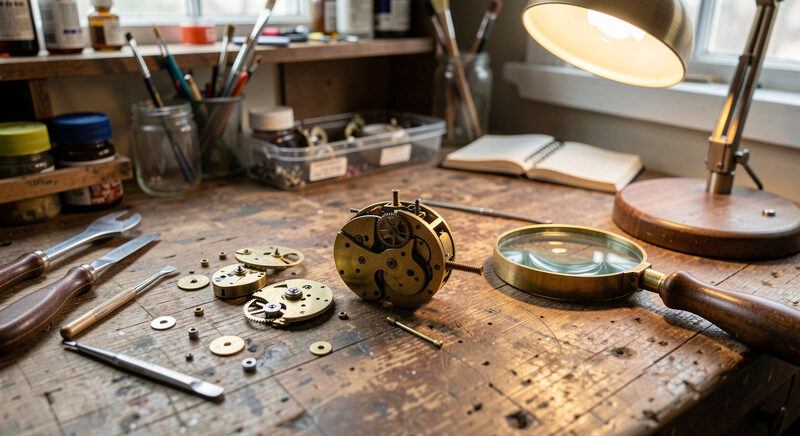
What restoration is, and what it is not
Restoration is not the same as repair, and it is not the same as rebuilding. A repair fixes what has broken. A rebuild replaces much of what is worn. Restoration sits between the two: it makes the clock run and look well while keeping the original material wherever that material can still do its job. The aim is a clock that is honest about its age, not a clock that pretends to be new.
The line between restoration and rebuilding is where most arguments begin. Two restorers can look at the same clock and disagree about whether a worn wheel should be repaired or replaced. The sensible rule for a collector is to ask what has been kept, what has been replaced and what has been added, and to want the answers in writing. A restored clock with a clear account of its work is worth more than a silent clock with a hidden history.
Cleaning the movement
The first work on any clock that has been still is cleaning. Dust, old oil and metal grit collect in the pivots and the wheel teeth, and left alone they grind the movement down. A proper cleaning means taking the movement apart, cleaning each part, checking for wear, and putting it back together with fresh oil in the right places and nowhere else. Oil applied to a dirty movement does more harm than good, which is why a clock that has been oiled without being cleaned is a warning sign rather than a comfort.
During cleaning, the restorer examines each pivot and each bearing for wear. Pivots that have become oval, holes that have grown large, and teeth that have been bent are all found at this stage. Some of this wear can be corrected by careful work on the original parts, and some of it calls for a new bushing or a new pivot. How much of the original metal survives is one of the questions a collector should ask.
Springs, weights and the power train
The power train carries the energy that runs the clock, and it is where age shows most clearly. Mainsprings lose their strength, suspension springs break, and weight cords fray. A suspension spring is a small, cheap part and replacing one is normal. A mainspring is a larger matter, and a restorer will weigh whether the original spring can be kept or must be replaced with a modern one of the same strength. Weight driven clocks are simpler here, because a cord and a weight can be renewed without touching the movement's heart.
The striking and chiming work deserves the same care. A clock that strikes the wrong hour, misses a strike or chimes out of step has a fault in this part of the movement, and it should be set right as part of the restoration rather than left for later. A clock that keeps good time but strikes badly is only half restored.
The case and the dial
The case and the dial are where a restorer must be most careful, because they carry the clock's history in a way the movement does not. A case should be cleaned and conserved rather than stripped and refinished. The old surface, with its wear and its colour, is part of the object, and a case sanded back to bare wood loses value as surely as a movement loses value when it is rebuilt. Loose veneer can be glued, missing mouldings can be replaced in matching wood, and a broken foot can be repaired, all without erasing the age of the piece.
The dial is the most delicate part. A painted dial should be left alone if it is stable, even when it is faded, because repainting destroys the original work and fools no one who knows the period. An enamel dial with a chip can sometimes be stabilised without being repainted. A dial that has already been repainted is a fact to be recorded, not a fault to be hidden. A collector should be suspicious of any clock whose dial looks newer than its case.
Wiring and safety on older clocks
Some clocks in the antique market are electric, and a few are early electric clocks from the first decades of the twentieth century. Their wiring is old and should never be trusted. A clock that plugs in should have its cord and its connections checked by someone qualified before it is used, and a collector should treat old insulation as a hazard rather than a detail. The same caution applies to any clock with a lamp or a light inside it. Safety comes before originality in this one case, because a fire destroys the clock and the house together.
Judging a restored clock
When a collector is offered a restored clock, the questions are straightforward. What was done to the movement, and by whom. What parts were replaced, and were the originals kept. Was the case conserved or refinished. Was the dial left alone. Is there any record, such as a photograph of the movement before the work or a note from the restorer, that shows what changed. A seller who can answer these questions is selling a clock with a known history. A seller who cannot is selling a mystery.
A restored clock is not worth less than an unrestored one, provided the work was honest and the original material was respected. Many clocks could not run at all without it. The point is to know what has been done, so that the collector is buying the clock in front of them rather than the clock they imagine. The dating guide on this site explains how to place a clock in time before restoration begins, and the antique clocks guide sets out the families of clocks and how to read one before you buy. A collector who reads both will know what to ask a restorer, and why the answers matter.