China, Glass and Porcelain
Fake Nippon Marks: How to Tell a Genuine Backstamp from a Copy
How to tell a genuine Nippon or Noritake backstamp from a fake: why Nippon means 1891 to 1921, which Morimura marks were copied, and what a copy fails.
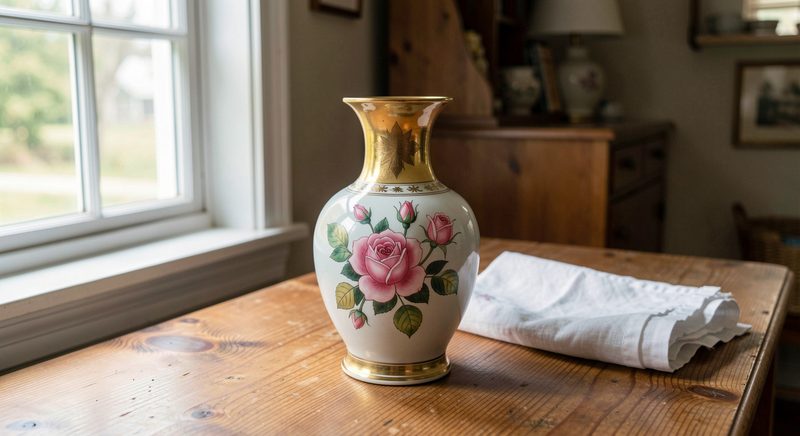
Why does the word Nippon date a piece?
The word on the base is there because of an American law. The McKinley Tariff Act of 1890 required that, from the first day of March 1891, imported goods of the kind usually marked be "plainly marked, stamped, branded, or labeled in legible English words" with their country of origin, or be refused entry. Japanese exporters met the rule with Nippon, the name of their country written in Latin letters.
In 1921 the American customs authorities decided that Nippon was a Japanese word rather than an English one, and from then on Japanese porcelain for the American market was expected to read Japan. That decision is what turns a single word into a calendar. A piece marked Nippon was, in principle, made for export between 1891 and 1921. A piece marked Japan or Made in Japan belongs, in principle, to the years after.
The words in principle matter. The rule applied to goods entering the United States, not to every market, and paper labels that once carried the country of origin have often washed off or fallen away. A piece with no mark is not automatically later, and a piece with the word Nippon is not automatically early. The word opens the inquiry; it does not close it.
Which Morimura marks are copied most often?
The marks most worth copying were those of Morimura, the trading house behind the company now called Noritake, because its ware has long fetched the highest prices. Ichizaemon Morimura set up the firm Morimura Gumi in 1876, and his brother Toyo opened the Morimura Brothers store in New York to sell Japanese goods to American buyers. In 1904 the family established Nippon Toki Gomei Kaisha and built a factory at Noritake, near Nagoya, the forerunner of the modern company.
The International Nippon Collectors Club, whose founding member Joan Van Patten spent decades recording the marks of the period, sets out the sequence of the principal Morimura marks. From about 1891 to 1911 the firm used a Maple Leaf, printed in green, blue or red. From 1911 to 1921 the Maple Leaf gave way to the M in Wreath, found in green, blue, red or gold. Around 1911 the company also introduced an RC mark for its new Royal Crockery line and a mark known as the Rising Sun, found mostly on practical wares. The club lists copies of all four.
| Mark | When it appears | What the collector should know |
|---|---|---|
| Maple Leaf with Nippon | About 1891 to 1911 | Green, blue or red; among the first Morimura marks to be copied |
| M in Wreath with Nippon | 1911 to 1921 | Green, blue, red or gold; the most closely copied mark, and the fake version was ruled counterfeit by U.S. Customs |
| RC, Royal Crockery | From about 1911 | Marks the Royal Crockery line; genuine pieces show the bright white, thin Morimura body |
| Rising Sun | From about 1911 | Found mostly on practical wares rather than on decorative vases and urns |
| M in Wreath with Japan | After 1921, before 1953 | A genuine mark of the later period; the word Japan is correct here and is no sign of a fake |
| N in Wreath | After 1953 | The letter N for Noritake replaces the M for Morimura |
When did the fakes appear?
According to the club, collecting Nippon began in the 1970s, and by the 1980s rising prices had drawn in firms willing to copy old pieces or invent new ones. The early copies of the Morimura marks were loose and easy to spot. Later ones came so close to the genuine M in Wreath that experienced collectors could be confused. Through the efforts of Noritake, U.S. Customs ruled that the fake M in Wreath was counterfeit and could not be imported. Wholesalers then stopped putting fake Noritake backstamps on the ware and shipped the same pieces with paper labels that came off easily, leaving an unmarked object ready for a fresh claim at the next sale.
The club sorts problem pieces into three kinds, and the distinction is useful at a flea market table. A reproduction copies a genuine Nippon pattern or mould. A fake uses a pattern or a mould that never existed in the period. A fantasy piece is a form that was not sent to the United States in those years at all, such as an oyster plate, a kerosene lamp, a wall pocket or a wine cooler. A fantasy piece needs no expert: the form alone rules it out, whatever the base says. The club also points to one design that turns up again and again among fakes, a floral pattern known as Wildflower.
How does a fake give itself away beyond the mark?
A mark is far easier to copy than the porcelain under it, and that is where most fakes fail. Morimura developed a thin, light, translucent white body after sending its people to study the leading European makers, and the club describes genuine late Maple Leaf, M in Wreath and RC pieces as bright white, light and well balanced in the hand. Earlier Maple Leaf pieces can look slightly grey while staying thin and light. A heavy, thick or chalky body under a crisp Morimura mark is the first warning.
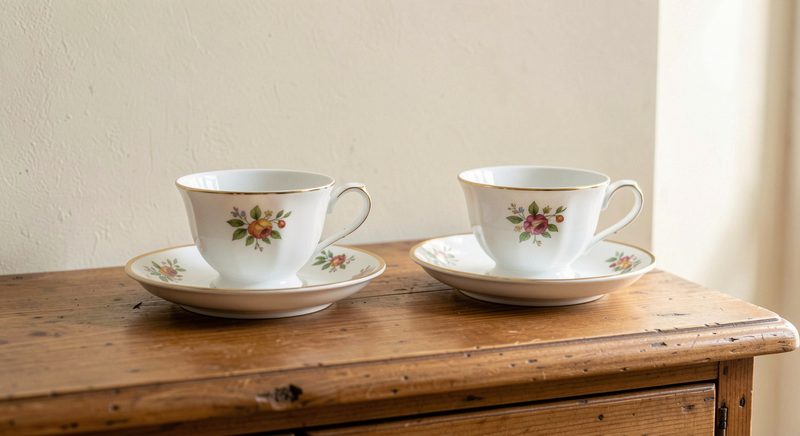
The gold is the second test. Genuine gold work, laid on as brocade, scrolls or pendants, was applied by hand and has a warm, soft lustre. Fake gold tends to look brassy and harsh, or is applied unevenly. The glaze is the third: on genuine ware it is even, light and smooth, close to invisible. The painting is the fourth. Fakes seldom attempt the slow, layered techniques of the period, and the club reports finding no fakes decorated with Coralene, sharkskin, moriage, tapestry, silver overlay, enamelling or oil spot work. A piece with raised moriage slip decoration is therefore far less likely to be a modern copy than a plain painted floral dish.
Noritake gives the same advice in fewer words. Its own guide to identifying its ware warns that its backstamps have occasionally been copied or applied to pieces it did not make, so the quality and style of a piece must match the period the mark suggests. Once a mark has passed, the remaining questions are those of any service, and the guide to Nippon and Noritake porcelain on this site covers gilding wear, damage and completeness. A rim that has been mended and painted over can hide behind a perfect mark, and the page on how porcelain is glued, filled and retouched describes what a restorer's work looks like under a strong light.
Is a Noritake mark without the word Nippon a fake?
No, and this is the mistake that sends good pieces to the wrong pile. The word Nippon belongs to the export years up to 1921. After that, genuine Morimura and Noritake ware reads Japan or Made in Japan, often inside the same wreath. Noritake's guide explains that the letter inside the wreath is an M for Morimura on marks before 1953 and an N for Noritake after 1953. The company completed its first Western style dinner set, exported to the United States, in 1914, and it only took the name Noritake Co., Limited in 1981, having traded under the name Nippon Toki since 1904.
A Noritake dinner service with an M in a wreath and the word Japan is therefore an ordinary piece of the 1920s to the early 1950s, not a doubtful one. The piece to question is the one whose mark says Nippon while its body, its gold and its painting say something else. The mark and the object must tell the same story, and when they disagree, the object is usually the one telling the truth.
How should a collector check a mark before buying?
A sensible routine takes a few minutes and needs only a good light and a reference. Read the mark first: the words, the device and the colour. Then set the mark aside and read the piece as if it had none: the weight in the hand, the whiteness and translucency of the body held against a lamp, the evenness of the glaze, the tone of the gold and the quality of the painting. Last, bring the two readings together. Where they agree, the piece has passed. Where they disagree, the price should reflect the doubt, or the piece should stay on the table.
For the mark itself, the standard reference is the numbered sequence compiled by Joan Van Patten. Her first book, written in 1979, recorded 118 marks; by her last, in 2005, the section of backstamps had grown to 359, and collectors still quote marks by their JVP number. The International Nippon Collectors Club publishes those backstamps in booklets on its site and keeps a page on reproduction, fake and fantasy Nippon with a comparison of real and fake marks. A mark that matches a known fake settles the question. A mark that matches no reference at all is not proof of a fake either, since the club notes that genuine marks of the era are still being discovered.
The same habit serves the rest of the table. Marks on English, German and American porcelain changed with their makers too, and the china, glass and porcelain section sets the reading of marks beside the pressed glass and tableware that shared the same cupboard.
A piece bought on the strength of its backstamp still has to reach home in one piece, and the guide to carrying antiques by car explains how to wrap and load painted porcelain with gilded edges for the drive.
Questions collectors ask
Are all Nippon marks with a wreath fake?
No. The M in Wreath is a genuine Morimura mark, used with the word Nippon from 1911 to 1921 and with Japan afterwards. It is also the mark most closely copied, so a wreath calls for the full check of body, glaze, gold and painting rather than a verdict on sight.
Can a piece marked Nippon have been made after 1921?
Genuine export ware marked Nippon should date from 1891 to 1921, because the 1921 decision required Japan on porcelain entering the United States. Porcelain carrying fake Nippon marks has been made since the 1980s, when rising prices drew in copyists, which is why the word alone dates nothing.
What does the letter in a Noritake wreath mean?
According to Noritake, an M inside the wreath stands for Morimura and appears on marks before 1953, and an N stands for Noritake and appears after 1953. Neither letter points to a fake on its own; what matters is whether the wording, the device and the piece itself agree.